To appreciate the rich history of music in Detroit, you have to examine the dynamic relationship of its composers and performers with jazz.
It is not a secret. But it is a fact not widely known. Jazz legend Charlie Gabriel played with Motown’s legendary singer Mary Wells. This is but one of many threads that secure Detroit’s fabled music to the allure of New Orleans and its evolution of African slave rhythms first heard on Congo Square in the 1700s.
At the 2012 Detroit Jazz Festival, Clarinetist Charlie Grabriel celebrated his 80th birthday, playing at the Absopure Pyramid Stage and at the Carhartt Amphitheatre Stage.

Born in 1932, Charlie Gabriel grew up surrounded by music. His great grandfather was a bass player who arrived in New Orleans from Santa Domingo in 1856, four years after pianist John B. Dolph’s great-great-great grandfather moved to the Black Swamp south of Detroit and helped to found a flourishing agricultural and industrial community that brought the best musical acts to its opera house. His forebears were helped greatly by prominent Detroit contractor J. H. Laurie.
To quote the MetroTimes coverage of the Detroit Jazz Festival: “’When you get to hear [Charlie Gabriel] play, you’re hearing 100 years of music,’ says Ben Jaffe, director of Preservation Hall, the New Orleans institution dedicated to keeping the jazz tradition alive. ‘It’s not only in the traditional music, but the influences he carries. I always say honor and respect the past, but also make room for your own voice, leave your own mark on the tradition, stay relevant and never become a museum piece. We are the people who learned from those who stood shoulder to shoulder with gentlemen like King Oliver and Louis Armstrong. Their music flows down through us. There is a lot of responsibility that comes from wearing those shoes.’”

Today, as a piano performer, and as a piano teacher, Detroit’s John B. Dolph nourishes these traditions of music in Detroit as he plays at the city’s live music venues, including Cliff’s Bell’s, the Chop House, the Detroit Athletic Club, the Atheneum, Keystone Underground (Ypsilanti), Joe Muer’s (Detroit), and the Rattlesnake Club.
This is not a two dimensional history that Dolph and other Wayne State University educated musicians read, but rather hear and feel. Like all jazz performers, John integrates his feel for the music and moves it forward, painstakingly writing out his arrangements, and yet also spontaneously performing the music to match the feel of the night and venue. Both tradition and the future exist simultaneously.
Feel is always an important driver of innovation. For example, much of the Motown Sound came from the use of overdubbed and duplicated instrumentation. Its tracks recorded two drummers, either overdubbed or in unison, as well as three or four guitar lines. Dolph’s own compositions are being performed on YouTube https://www.youtube.com/channel/UCN1aO4T646MJ2MOmVcwTs5w and the radio by some of Detroit’s leading performers today, including a group who has been signed by Atlantic Records after recording one of John’s Techno compositions. As noted above, music in Detroit many threads.
 Looking back centuries, did jazz really begin when enslaved Africans were unloaded on the docks of New Orleans and make its way north up the Mississippi and Ohio Rivers and across the Great Lakes? Surely, the answer must be more diverse to align with the culture of African-Americans.
By 1810, the population of Detroit had 96 nonwhites, including 17 Indians and 17 slaves. By 1840, the population of African Americans had grown to 200 souls who proved industrious and self-organizing. Unlike the Black sections of New York and New Orleans, Detroit Blacks worked as skilled artisans and business people who ran clothing stores, bakeries, barbershops, catering companies and other vital services. The Census of 1850 reports that just one musician lived in Detroit. If you believe that jazz sprang from crowded slums and illicit activity, Detroit’s Black community was not an incubator. Blacks, like Anglos, came to Detroit to work.

Music in Detroit: continuous ties to New Orleans but sounds and syncopation of its own.
And yet…
Both Detroit and New Orleans are legendary music centers with history. Detroit has its famous jazz clubs of the 1920s, ‘30s and ‘40s where the sounds and syncopation were much different than Chicago and New Orleans. After that, Motown came to dominate the 1960s AM radio and 45 RPM record sales, and more recently Detroit’s Techno is the bad boy of streaming as well as FM and social media.
The Detroit Jazz Festival is thirty-four years old this year. Today, Detroit has talent like Eminem, Aretha, Carl Craig, and Bob Seger, and an entertainment district second in size only to New York City. In Detroit today there are hundreds if not thousands of others producing or performing music.
New Orleans has Jazz, Zydeco, the Marsalis family, the Neville Brothers, Dr. John, Irvin Mayfield, and others. But when Hurricane Katrina struck, many New Orleans musicians took financial refuge in Detroit and some have stayed to expand Detroit’s burgeoning music scene.
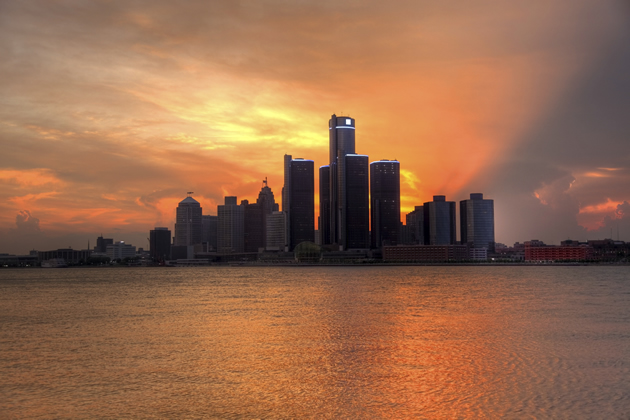
The evolution of music in Detroit: bands – jazz – MoTown – Hip Hop – Techno
Looking back, the Fugitive Slave Law was passed in 1850, exposing runaway slaves to legal and aggressive recapture, and so many African Americans moved through Detroit to cross the Detroit River, the same border river that seventy years later would protect and serve Al Capone’s bootleggers, and into Canada and freedom. But there was freedman’s group, as well. The Blacks of Detroit had established a permanent residency and this community attracted and hid its share of southern Blacks who had moved into the area. This well organized effort created an expanding community on Detroit’s near east side that would later be known as “Black Bottom.”

By 1870, Detroit’s Black population was over 2,000 and yet there is no written record of jazz being played in the community. But who kept such records? This was the decade that entrepreneurial musician Theodore Finney came to Detroit from Columbus, Ohio and began to make his reputation.
Finney was a gifted and versatile man who also embraced business and civic affairs. Acquiring a partner, the Bailey and Finney Orchestra was among the first bands to feature syncopated music. After his partner’s death Finney’s orchestra performed on board the steamer Frank Kirby during round trips between Detroit and Sandusky, Ohio.
For the next 20 years, Finney’s orchestra trained many of Detroit’s finest musicians, including Fred Stone and Ben Shook, both of whom later led their own bands.
Finney’s orchestra, and groups that sprang up like it, played occasional music, with repertoires that supported parade marches, concerts at picnics, and political rallies
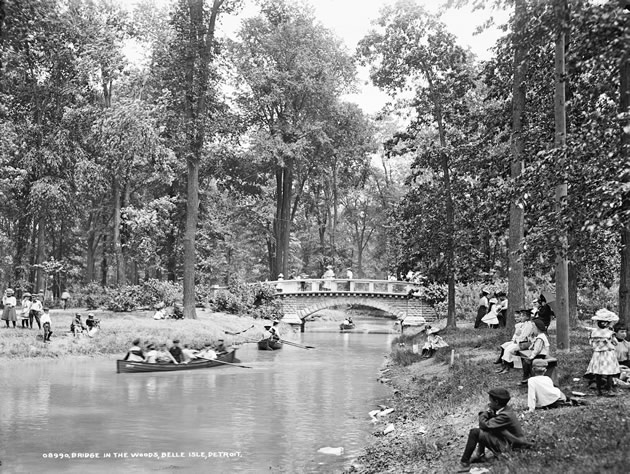
A proliferation of brass bands was well under way by 1890, when John W. Johnson settled in Detroit. Born in Ontario and trained as a cabinetmaker, Johnson spent time playing the cornet instead of building cabinets, and he abandoned his craft to join a Wild West show and toured across Canada before joining Finney’s orchestra in Detroit. Finney’s example led Johnson to organize his own band, which began to play everywhere in Detroit, winning accolades for its Sunday Belle Isle performances at the Germania Turner Hall. Just as Finney, Johnson’s band was an incubator for a rising cadre of Detroit musical talent.
 Despite Johnson’s Detroit brass band and the brass bands led by John Robichaux in New Orleans, the relationship with these Black musicians and jazz is both debated and affirmed. Often, they played to customer demand for John Phillip Sousa. In Detroit, this dispute grew to include the separateness of jazz, Dixieland, blues, ragtime and the music of the brass bands. And yet, as pianist and music teacher John B. Dolph recalls of his first year training as a musician at Wayne State University a few years ago: “When we gave our first class concert, Professor Ernie Rogers, one of the famous Funk Brothers, directed and the famous trumpet masters of Motown legend stood in the back row and blew their brass like no one I had ever heard live before.”

Harry P. Guy was another African-American musician who came to Detroit from Ohio and performed in Finney’s orchestra. Both an organist and a pianist, Guy was an accomplished composer who advanced Finney’s syncopation and whose arrangements were adopted by Eddie Cantor, Bert Williams and Sophie Tucker. Certainly, the premiere Ragtime performers of the day came to Detroit to play with Guy, whose reputation as an excellent pianist, arranger and composer had won him business relationships with the leading music publishers of the day. While the origins of Ragtime are in dispute, Guy claimed that Ragtime started in Detroit. Performing as an organist at St. Matthew’s Episcopal Church, Guy brought classical music to the music of the Black church. Guy also performed as an accompanist for the internationally known Fisk Jubilee Singers
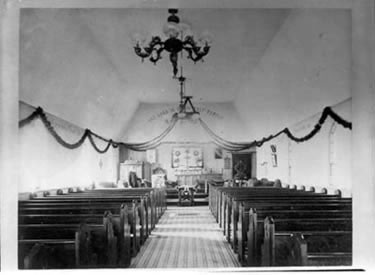
and St. Joseph’s Episcopal Church Records,
Box 3, Bentley Historical Library
The music and performances of Guy, along with Fred Stone and Ben Shook, attracted a young William Christopher Handy to Detroit to usher in another generation of innovation in the 1890s. Ragtime had come to Detroit, to be followed by the Blues, and Guy both saw and heard it begin.
Quoting from Herb Boyd’s The Beginning: Black Music In Detroit – 1850—1920: “Actually, it was after attending a rehearsal of the Fred Stone Orchestra that Handy, who had traveled all over the country as a cornetist with a circus band, first heard the moving syncopation of a Detroit band. Handy, from his autobiography, Father of the Blues, recalls this visitation: ‘… I had a secret plan to include a stirring ragtime number, My Ragtime Baby, which our minstrel band had featured. It was written by a Detroit Negro, Fred Stone. I rewrote the highstepper and programmed it Greetings to Toussaint L’Overture so that the manuscript sheets would create the impression of classical music without changing a note of the original.’”
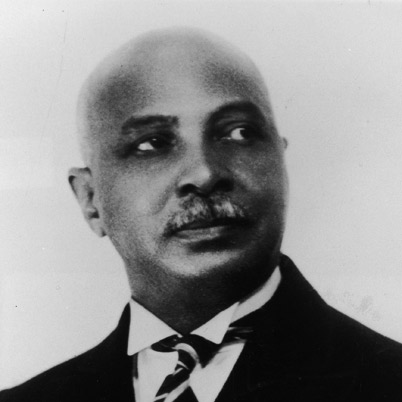
Handy played his distinctive sound at the Chicago World’s Fair in 1893 and continued to travel widely, both to collect unique local music, as he had in Detroit, and then adopt their form in his own performances. Handy published sheet music for Memphis Blues in 1912, introducing his 12-bar blues sound. It is believed to be both the first blues song and the inspiration of the foxtrot dance step first performed by Vernon and Irene Castle in New York. In any case, Memphis Blues was Handy’s first major success after the Victor Military Band recorded it on July 15, 1914.
William Christopher Handy continues to be a highly influential American songwriter. At a time when many Black musicians played a distinctive American music which came to be called “The Blues,” Handy brought such a level of sophistication to his syncopated arrangements and performances that the blues transcended its regional appeal to become a dominant expression of American music….
*There is more to come. This is a work in progress. Photos are purchased or believed to be in the public domain. Please send any suggestions and notices of errors or corrections to john@johndolphmusic.com.